You Should Have A Blog
Yo! Hey! Hiya! Thanks for comin’, great to see you!#
Without a doubt one of the hardest things to do is to start something. Whether that’s a new homework project, an awesome software idea, an interesting writing article, or even this very blog1. I’ve personally found I have to be weary of getting stuck in a perpetual “ideation loop” where I continually think and think and think about the concept of starting and how I should start as opposed to actually acting on the concept. In this case, writing.
In this deep rumination, brain storming possible first posts I realized that I’d keep asking myself the question, “Why?” After all, you might be thinking, “It’s [Current Year Here] now didn’t people leave blogs behind with dial-up and XMP?” Or, “You’re a CS major, what possible reason could you have for blogging?” So on, and all the other questions suggesting blogging is some irrelevant or lost art.
So when I sat down to write “Why You Should Read My Blog” I came to realize a lot of the reasons I listed were why everyone should have a blog. So I write to you why you should have a blog (and in turn retroactively justify why I started one).
Being Creative is Extremely Attractive#
Here’s one fun reason you should have a blog! Studies have been able to show that “creativity” has a positive correlation with perceived attractiveness (at least for men)2. And there’s a variety of reasons3 that could explain this. To me it would appear that:
- Creativity requires authenticity, a well appreciated trait in relationships
- Creativity demonstrates agency which helps to showcase self-sufficiency, uniqueness, and competence
- Creativity is an intelligent task, there’s a reason some of the most ‘popular’4 thinkers were also creatives and ‘Renaissance men’5
- Creativity necessarily requires an open mind to be receptive to new sources of inspiration and to evolve their work
- Creative things are beautiful, and people who make beautiful things are beautiful lol
Naturally, a blog would be one way to improve and demonstrate creativity since this should be an authentic, high agency task and hopefully improve my perceived attractiveness. Is what I would say if I was a narcissist, it’d be quite shameful to the human condition to only engage in something purely because it made you seem hotter ;) ;)
“Being Different” vs Being different#

I’m Spartacus
But how do you be creative? At a bare minimum, it requires both taste and personality6. You need personality to create something of substance which is why AI can not create the same way people can7. And you need taste to be able to critically evaluate and evolve the work of your creation which AI can not do on its own8.

Even the technology sector understands, without discernment nothing of value can be created. We’re seeing companies invest big time into bonafide artists to evaluate and their AI models and their outputs, and the question of “what is AI slop” is becoming more and more important no matter where you stand or what you think about AI.
Yet despite how important taste is we’re seeing people struggling to describe what actually matters. One curious result of this is the increase in language labeling things that belong to a category as “X-slop” such as “friendslop”, “shonenslop”, and even “qualityslop” (THIS IS LITERALLY A CONTRADICTION). If you know what these terms refer to you understand that NOTHING is safe from these words. No matter how well regarded or deserving of its popularity a piece of work is, there is a distinct lack of discernment applied when using these terms. Rather the effort goes into surface level categorizations of media into “X”. Which in the context of social media’s incentive to expose as much information as humanly possible, is a far more efficient (but taste-free) way of engaging with media.
Algorithmic processes also homogenize taste and “personality”, both due to the economic incentive to only promote what will be or already is popular and through the ways it tries to target people through data analysis techniques as well. Collaborative filtering being one example.
Here’s the general process of collaborative filtering: Say I had a crush on you and wanted to know more about you without talking to you directly (because I am very shy). To do that I’d probably go talk to your friends since they’d be the most similar to you, see what they’re saying about you, what interests they share with you, what they like and dislike about you. And I may weigh these different judgments based on how similar the person I’m interrogating is to you. Hopefully, after interrogating enough people I should have a pretty good idea of what you are like and can begin plotting appropriately.
Much in the same way, an aspect of social media algorithms extrapolate what you like based on what users with similar interests like and learns what they like from what you like. This can actually turn out to be a good way to learn about someone but there’s also a feedback loop that occurs with algorithms. You also develop a taste for what you like based on the content algorithms show you. So as you engage in social media, collaborative filtering exposes you to the algorithms of similar users and more of your algorithm to your ingroup, until eventually you share a homogenized popularized taste in your preferences with respect whatever group of users the opaque algorithm decided. Filter bubble, is the terminology for the phenomena and other algorithmic tendencies and regulations (such as moderation and popularity bias) can also go into creating one, not just collaborative filtering10.
So by default social media negatively impacts one’s relationship with creation in general. I’m not denying there’s plenty of ways to engage with social media more thoughtfully but the “old internet” and blogs definitely win here. Personally, one of the biggest inspirations for this blog was simply the uniqueness in perspective and background of bloggers while casually perusing technical content. One website I want to especially point out is People and Blogs and the community formed there around the love for blogging. For bloggers, their enterprise could not exist without due credit to their inspiration and community as a whole leading to a culture of back-linking to blogs they support or draw inspiration from. In contrast, short form content by definition limits how much you can actually say (from bios to captions) so more emphasis is placed on disseminating ideas, leaving little room for acknowledgements anywhere. A blog provides a blogger as much control over their content they want so naturally, their outputs reflect their full selves and their ideas much better than rigid social media structures do. And readers who are further interested in the ideas of a blogger naturally have far more to go off of compared to the ‘itemized novelty’ treatment ideas have on social media.
The Privilege and Obligation to Share Knowledge#
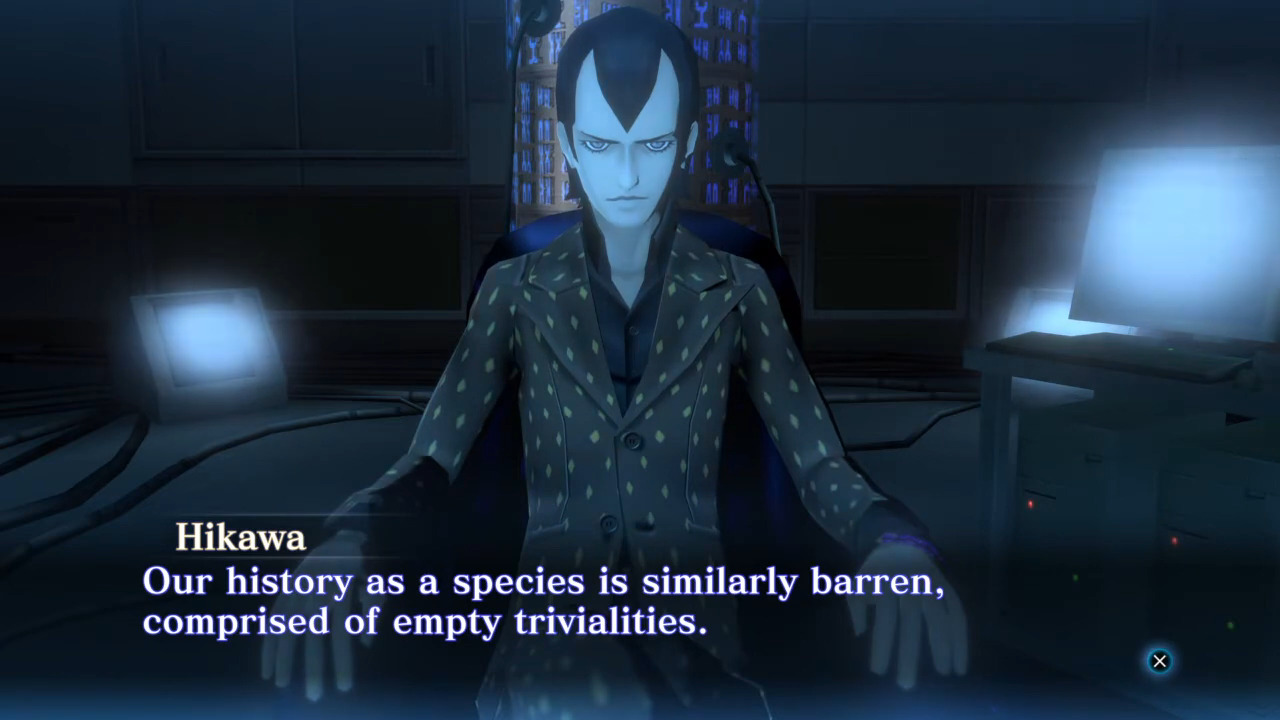
You know what’s odd? This is like the only nihilistic character I could find (that I cared about) occurring at the start of a story, as opposed to the end like most media (that I care about)
Immortal apathy is a common trope amongst undying or long lived characters, crumbling underneath the overwhelming breadth of their experience to create someone who has lost all sense of meaning in the world they live in. Does that sound somewhat familiar? In a way, the apathetic immortal has lost the ability to discern what matters in the world and to them. Without a limitation on what they can see, know, and do, and an ultimate purpose/end goal (i.e. death), their sense of selves slowly diffuses, leaving behind a jaded soul, full of wisdom yet none of the agency to act on it.
I’m guilty of doomscrolling as much as anyone reading this is. Even when it’s not doomscrolling, I’ll come home to my parents asking me my thoughts on the recent tragedy that they heard from the news that day. I’ll check in on a friend’s story and find out what new fad I have to be mad, sad, and/or glad about. Pundits and grifters spend every day telling us how we ought to spend our money on them for whatever moral rubric they think earns them the most money. We are always told what’s wrong and when we ask how do we fix it the most popular answer is to engage in more consumption, “read this”, “buy this”, “watch this”, and so on. With our ability to consume somehow growing stronger yet the skill of truly ingesting growing weaker at the same time we’re left in a metaphorically catatonic state, having lost any sense of power or agency over our lives and our world.
How do you even begin to process all of this? In a world that has so much it simply MUST tell you how do you begin to even get through it all sane?
I’ve chosen to write about it.
In a sociological perspective, knowledge is almost an obligation of sorts to share. Communities can not survive and evolve beyond their biases and states without the introduction of new ideas from fringe members and members who otherwise bring perspectives to the group. But on the current web, ~1% of users generate most of the content online. Almost all of modern internet lingo and terminology comes from the small subset of posters on 4chan11. One could argue that with such a small minority essentially deciding everything that people think is cool and hip its no wonder that memetic warfare12 remains so effective today.
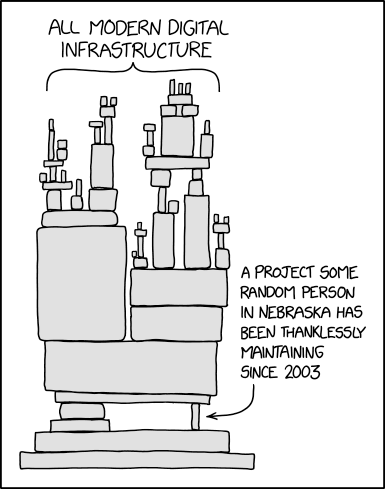
It wouldn’t be a tech blog without XKCD. https://xkcd.com/2347/
Furthermore, such a small percentage of the world contributes, creates, and develops an overwhelming majority of the software we use today. What do we do when maintainers are unable to continue maintaining their software?
Unfortunately, knowledge also remains a privilege as well, one that shouldn’t be taken for granted. Time is an incredibly limited resource and schooling is not affordable to everyone. And that’s not even taking to account that organizations have been directly restricting people’s access to knowledge. Specifically, I’m concerned with how scientific articles remain largely inaccessible through legitimate means to the public and institutions without monetization. Why on earth do experts have little access by default to relevant information to do their work?
“It’s because in a capitalist system we rely on the exchange of money for goods and services. It’s fundamental attribute and this system has lead to widespread success globally.”
Okay, but then we’re left with messes like this, this, and this. Someone please explain to me how it makes sense that researchers pay the journals to publish and own work they did and how restricting access to research has been a widespread benefit for anyone (that isn’t an academic journal13)? If knowledge is a privilege journals forever leave researchers and the general public forever disenfranchised.
Software developers (and anyone who uses tech) face a similar restriction to knowledge as well, in the form of closed source software. The Free Software Foundation identifies four freedoms essential to software:
- The freedom to run the program as you wish, for whatever purpose.
- The freedom to study the program’s “source code,” and change it.
- The freedom to make and distribute exact copies when you wish.
- The freedom to make and distribute copies of your modified versions, when you wish.
Plainly, if popular software respected these freedoms today, it would be held to a level of scrutiny, accountability, and competition that the software industry despises from the depths of their silicon (valley) hearts. And much in the same way, these same freedoms are why tools like Linux are so pervasive14. Because people can scrutinize and modify as much as their will desires, which allows these open tools to take inspiration and modify user modifications resulting in a symbiotic feedback where software fits the user, not the other way around. The dialogue with the privilege to posses knowledge and the obligation to disseminate knowledge is what allows open source to make massive progress and rival closed source solutions despite the limited access to resources that open source has compared to companies like Google.
So how do you share knowledge? “Take your time” is relevant here, intentionally processing everything communicated and the manner/syntax in which it’s communicated. And if my intro wasn’t overt about this, blogs take a LOT of time. Richard Feynman actually has a technique named after him that describes pretty much what steps I went through as I made this blog. The Feynman technique proceeds as follows:
- Study the subject as interest
- Explain the topic in as elementary15 a way as possible
- Identify and improve knowledge gaps in the explanation
- Iterate!
Yet, despite how effective this technique actually is, I found that this ability to understand, process, and distill was something that was very rarely asked of me in high school16 while it has become something I’ve continually needed to do while in college and will more than likely remain important as I move on in my life and career. Of course, this proceeds counterculture to how tech CEOs want you to engage with information. After all, if you watched each video twice over, one for your eyes, one for your ears, that’s half as many ads they can show you. Not a fun business proposition for them…
AI and my Chopped Writing Skills?#
But do you need to know how to write? AI proponents would say no. Surely not, I mean it’s not like an important class divide throughout history was the ability to write vs not write. Yeah honestly, why did I even write this surely ChatGPT does better. ChatGPT knows all after all…
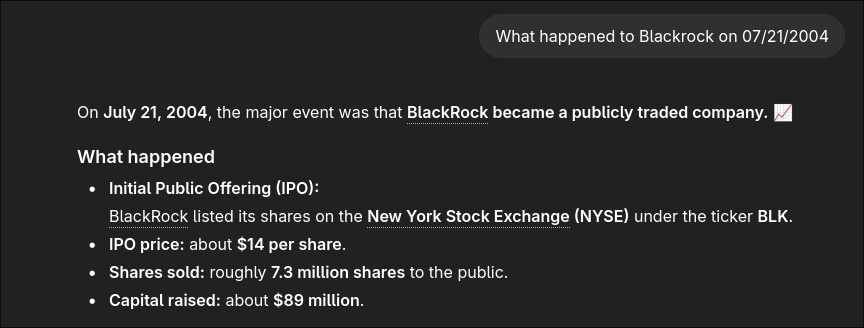
If this18 article is anything to go by, using LLMs as a substitute for off-the-brain and in-the-books writing could induce a cognitive developmental cost. Worse yet, it has a transformative effect, alienating people from semantics and deeper understanding of what they’re asking these LLMs to do, as if they’re becoming the semantically deficient LLMs themselves. With algorithmic and literal understanding of what to do but none of the context or metareasoning behind how or why of what they’re doing.
It’s obvious AI companies want to replace humanity, not supplement it. I could cope and say “but UBI!” but anything concerning the wellbeing of humans is obviously of no concern to MAMAA19. Rising controversies with AI data centers, AI-enabled sexual abuse, AI-“art”, Machine learning enabled social engineering, lackluster AI transparency, AI enabled privacy invasion, the lack of accountability with AI systems, and a plethora of other issues should make this more than obvious no matter how much Sam Altman claims, “AI won’t replace humans. But humans who use AI will replace those who don’t.”
- Fun fact: Sam Altman once said this: https://youtu.be/YE5adUeTe_I
There is a distinct lack of humanity present with AI and it’s proponents which becomes especially obvious when they attempt to engage in anything that requires a semblance of humanity.
That’s not even touching on the frightening lack of writing featured in current STEM education when fundamentally, industry and academia rely on individuals being effective communicators and having the capability to communicate complex ideas to groups of people who have not even a 1/4 of the background for understanding. Or worse yet, to people with your exact level of understanding! As the old adage goes,
There are 2 hard problems in computer science: cache invalidation, naming things, and off-by-1 errors.
– Leon Bambrick
So naturally, you should hopefully have enough of a command on language to be able to give variables and functions informative and descriptive labels and not opaque and generic ones.
All of this presupposes though that AI may actually overcome its performance plateau and somehow begin to demonstrate enough intelligence to write properly. But if the circularity of Silicon Valley investments, AI’s ingrained bias to generic popular outputs, and recent rehiring trends anything to go by, we are a very very long time from AI demonstrating a replacing capability.
Until then, I’ll keep developing my writing skills, and get marginally better at grammar :\/
Tech Literacy, a good reason but not necessary#
There’s enough AI doom in the world that I can get into here, but to be succinct, it’s critical to have some understanding of the tech used today to full understand what’s happening in the modern world. Why do AI companies need so much water? Why are GPUs and RAM so important to AI? How are companies even able to distribute this expensive service at such as massive scale? What is my office suite doing when I open it up? What ways can and should tech evolve in the future? How should I interact with the World Wide Web in [current year here]? All of these should be questions you can answer.
On the flip side though, it’s difficult to explain this to someone who hasn’t invested the time to fully learn why exactly this is important. Much in the same way a caveman wouldn’t be able to understand why calculus is so important until they fully learns what it describes and how it describes it. If you still aren’t entirely sure why I’m saying you should start learning about servers, coding languages, and Fediverse protocols (oh my!) I’d encourage you to attempt to peruse such content on the internet. You’d be surprised how much you may or may not know about the very device you’re reading on20!
Running a blog can be as technically easy or difficult you want it to be, from rolling your own hosting service and web stack to simply writing to Substack. My point here is that a blog is one fun and relevant way to understand the World Wide Web, websites, servers, coding, etc, etc.
Digital Presence, My Page My Rules#
I own an Instagram account like many other people in my age group. And like many others in my age group using the web has become an experience of exposure to infinite brand promotion. Even if I manage to escape from direct advertising, that doesn’t stop the sea of nebulous sponsorships (NordVPN and Honey I’m looking at you…), it won’t stop me from seeing all of those Cluely reels, and it won’t stop me from seeing the latest alpha male course to make 10k/month. In a fit of distress, I even left Instagram itself for a few years! Only to rejoin later on, finding similar issues no matter what platform I used and realizing I actually did like seeing how people I knew before were doing.
But it was the rise of the retro-tech trend that convinced me that subculture was dead on Instagram and it was time again to rethink how I’ve been using this platform. Watching people discuss, idolize, and perform the act of appreciating retro-tech was nothing short of soul crushing. Somehow this trend managed to discuss old school tech while divorcing it from the subcultures appreciation of:
- One thing per device (think UNIX philosophy)
- Reliability and Stability
- Privacy
All while turning retro-technology into a pretentious symbol of their “offlineness” while ironically recording and posting everything about it online.
In contrast, if it weren’t for blogs, I wouldn’t have the love of technology and computers the way I have today. And it’s because blogs respect and preserve a subculture’s identity naturally as a subculture itself. Blogging may have had a past of being a monetization strategy but, with social media pervasive reach, that has lost much relevance and staying power. As opposed to the previous article’s note on skateboarding, blogging is an economic dead end. The people who do it now are into what they have to write and say for their own sake and not money’s. And I think this is more than self-evident when you read the blogs I’ve linked in my about page. The sheer personality infused into every website and post is far more than social media could ever hope to achieve. The very same personality and passion that inspired a love of computers.
I’ve dabbled in more creative posting on Instagram through a spam account, but this is the first time I’ve felt more than excited to showcase something deeply personal to me21. Having been able to invest so much of myself and what I want onto a page has done wonders for how much more attached I feel to what I’ve created. Knowing what I’m writing here can go wherever I want, in both a technological and metaphorical sense, gives me a sense of ownership over this content that I definitely wouldn’t have otherwise. There’s power in both owning what you make and engaging with what is not necessarily economical.
Parting Thoughts#
I definitely love blogs but if that isn’t your style that’s fine. Maybe make something else. One of the important ways we regain autonomy in our society is recognizing we don’t always have to accept the communities and algorithms big tech wants to force. Acknowledging that we can produce our own communities of substance. That you have a voice and that you have an idea of what you think. The world will never have enough makers because it’s not about how many people are consuming. It’s about the unlimited access to so much knowledge we’ll almost never use or talk about. That if we’re going to listen and hear about so much that, in equal outputs, we need to voice and express how we feel about things in our world. The way dreams come to our world is through the tangibility of our creations, otherwise they just remain dreams.
Btw I don’t mean produce perfectly. In fact, produce wrongly. Write the worst, draw the worst, make the worst thing imaginable. Because society would have you convinced that the only way to learn is to read and read until you’re ready to write. But a lesson taught in a book is worse taught than the one taught by hard knocks. Knowledge unused and unprocessed is not knowledge at all, but rather useless information.
After all, sculptor doesn’t immediately have his statue. He first starts with rough carvings getting down the general shape. Then they refine to get some of the shading and depth down. And the sculptor keeps going refining more and more until they’re satisfied. You won’t write the book you’ve always wanted to in one go. You’ll jump around and make something incoherent. Then you’ll go through drafts and drafts until you’ve realized the abstract dream of yours. Really, the relevant part here is that you sat down and made something. Making something good can always come later. Society has always demonized being wrong or being flawed but there’s nothing wrong about it. Really, being wrong is an element of ignorance and poor teaching and not a failing of the person themselves. There’s nothing wrong with you if you’re wrong, but rather that you simply learned.
This took me over a year to write, My recorded start for writing this was at 2025-03-01T20:42:19-07:00. Altough basically all of the progress on this post happened in about the time span of a month. ↩︎
However, there may be an anti-correlation effect for women that are seen as less socially attractive (i.e. creative + unattractive women are seen as less attractive than uncreative + unattractive women). One possible immediate explainer being misogyny :/ ↩︎
Evolutionary psychology perspective might suggest creativity is an extended phenotype, genetically coded behavior that influences their behavior amongst their environment and other organisms. Evolutionary psych is obviously not sufficient for explaining attraction though lol don’t read this as anything related to pseudoscience grift but as a curious note. This article dives more into the purpose of creativity from an evolutionary perspective: https://www.frontiersin.org/journals/psychology/articles/10.3389/fpsyg.2022.874261/full#sec38 ↩︎
Scientific history is actually a lot more complicated than what I’m presenting here and I fear delving into this would take away from the point. In general, a lot of discoveries credited to a lot of these European thinkers were previously discovered by or combined from many different people in many different cultures. I’d love to write about specifics in a different post on but for now I point you to my friend’s (who’s actually much more educated in history) writings on the historical “great man narrative” here: https://genzsocrates.substack.com/p/on-legacies ↩︎
Descartes was a philosopher, Gallei was an artist, Condorcet was an activist, so on ad nauseam ↩︎
Note: I’m not saying individuality or ego. I’m not fully decided on this (and will likely interrogate this in the future) but I’m not sure if creation necessarily relies on an “ego” but rather some sort of ensemble “personality”. This article has examples that exemplify what I mean. https://medium.com/@alexlabarces/the-liberation-of-creating-without-ego-45aca4033846 ↩︎
No I don’t think AI is an ensemble of personality. See Searle’s ‘Systems Reply’ to the Systems objection to his Chinese Room Thought Experiment ↩︎
It’s still not generally applicable/preferable to human labelers and Reinforcement Learning with Human Feedback but this does technically exist https://en.wikipedia.org/wiki/Self-supervised_learning ↩︎
Xcancel is an alternative frontend to the X/Twitter platform, allowing you to view tweets without:
- signing in and making an account
- driving traffic to you know who and his you know whats
Research in reducing bias in the collaborative filtering algorithm: https://doi.org/10.48550/arXiv.2211.09324 ↩︎
Also a great place for government sponsored conspiracy theories. ↩︎
Worse, there’s evidence suggesting these especially prestigious journals don’t even reach average reliability. ↩︎
In anything that isn’t consumer hardware… Though this is because Linux emerged well after Microsoft and Apple fully established their hegemony over laptops, desktops, and later smartphones for Apple and Google. ↩︎
Not to say anyone reading this or anything you or I will write is elementary though! Just that there is beauty in simple accessible explanations. ↩︎
It’s kinda crazy how well you’re setup to fail in college since a common theme amongst high schoolers (me included) is a lack of ↩︎
This hallucination trick came from Reddit, see what you come up with! https://old.reddit.com/r/ChatGPT/comments/1dlq5f9/a_simple_set_of_prompts_with_100_hallucination/ ↩︎
This article has a section called “How to Read this Paper” that actually provides a good framework for reading papers in general. ↩︎
MAMAA: Meta, Apple, Microsoft, Alphabet Inc, and Amazon. ↩︎
Fun fact! Did you know, that when your device executes code it actually executes code “ahead of time” and executes conditions based on a probability on which code branch your environment will travel down? Even before you click on something your CPU may already be deciding if you will click on something and if it needs to render the page as such! See speculative execution on Wikipedia ↩︎
As for social media’s role now? I’ll turn them into POSSE endpoints, ultimately serving to direct people to the place where I actually want to represent myself. ↩︎